
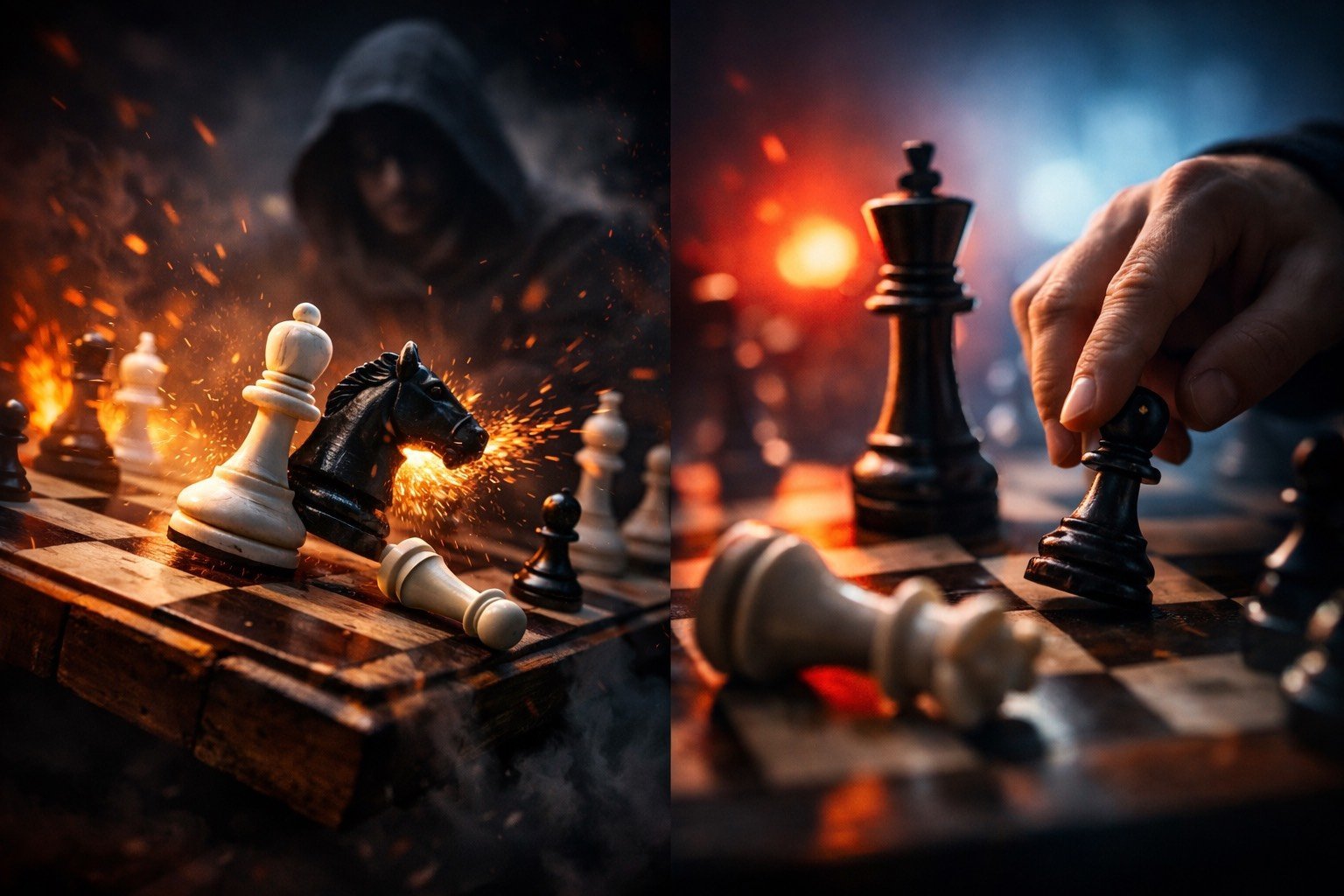
I used to think chess was about always finding the best move. Every position felt like a test with one correct answer, and my job was to calculate it perfectly. But the more I played, the more I realized something strange—some of my best wins came from moves that weren’t “perfect” at all.
Sometimes, I deliberately play moves that look slightly off. I might give up a pawn or allow a small weakness, not because I missed something, but because I want to change the nature of the position. When everything is balanced and predictable, it’s easy for both players to play well. But once things get messy, unfamiliar, or uncomfortable, that’s where opportunities start to appear.
I’ve noticed that I can get stuck repeating ideas without realizing it—defending the same squares, improving the same pieces, going in circles. When that happens, I force myself to break out of that pattern. I reroute a piece in a way that feels unusual or shift my focus to a different part of the board. Almost every time, something new opens up.
Instead of always attacking directly, I often try to make my opponent’s position just a little worse with each move. A slightly awkward piece here, a pawn that can’t move there. None of it looks decisive on its own, but over time those small issues start to add up. Eventually, they reach a point where the position just collapses without a clear turning point.
There are also moments where I have to accept a tradeoff. I might weaken my pawn structure to activate my pieces, or delay an attack to improve coordination. I’ve learned that trying to maximize everything at once doesn’t work. The game is really about balancing advantages and choosing which ones matter most in that moment.
One of my favorite ideas is guiding my opponent into positions that look solid but aren’t. They think everything is under control, but their pieces are slowly becoming restricted, or certain squares are getting weaker over time. By the time the problem becomes obvious, it’s often too late to fix it.
And when a position feels completely blocked, I don’t always wait patiently. Sometimes I pick a single point and go all in, even if it means sacrificing something. Breaking through in one place can be far more powerful than slowly improving everywhere else.
What fascinates me most is how often my opponent is forced into difficult choices. If they fix one problem, another one appears. If they improve their structure, their activity suffers. I try to keep them in that state—where no move feels fully right.
I’ve also learned that players sometimes lose because they try too hard to be perfect. They focus on fixing one small detail, and while they’re doing that, the rest of their position starts to fall apart. When I sense that, I shift the game somewhere else and take advantage of the imbalance.
At some point, I stopped thinking of chess as a search for the single best move. Instead, I started seeing it as a space of possibilities—where creating the right kind of problems matters more than solving everything perfectly.
And that’s when I began to wonder: what if the move that looks wrong is exactly the one that wins?
Written by codexnova in Indonesia — CHESS coverage, published on April 10, 2026.

Leave a Reply