
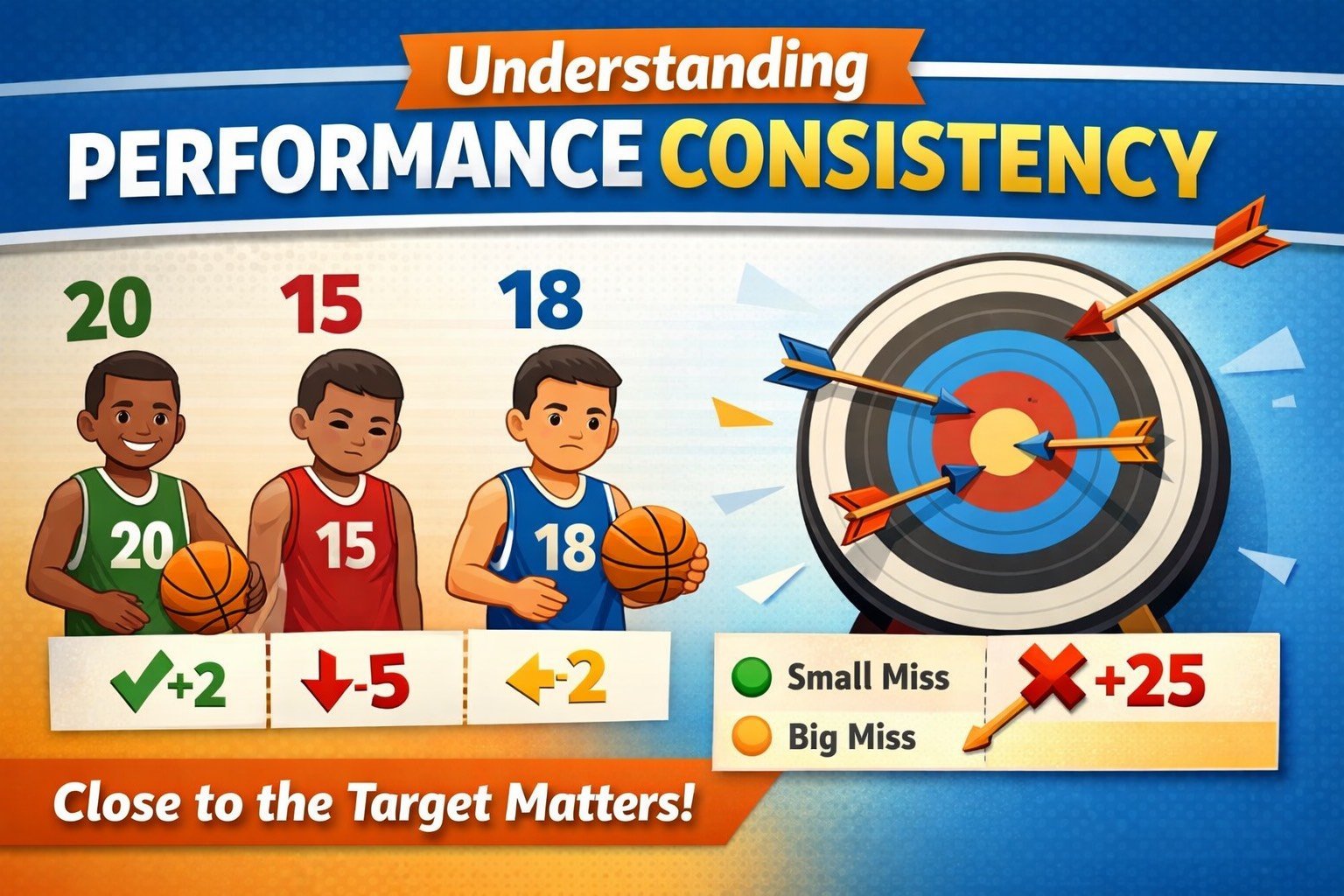
I wanted to share a straightforward way I think about performance consistency using a basketball-style example.
During practice, each of us has a clear target:
-
Player A: 20 points
-
Player B: 15 points
-
Me: 18 points
After the session, the results are:
-
Player A scores 22 → 2 above target
-
Player B scores 10 → 5 below target
-
I score 16 → 2 below target
Instead of focusing only on totals, I look at how far each result is from the target.
Here’s a simple way to quantify that:
-
A small gap of 2 becomes 4
-
A larger gap of 5 becomes 25
-
Another small gap of 2 becomes 4
When these are averaged, the overall consistency score is 11.
What this shows:
-
Small differences have a limited effect
-
Larger gaps have a much stronger impact
-
One big miss can outweigh several small ones
In this case, the largest gap contributes most of the total impact.
Key takeaway:
I focus on staying close to expectations rather than just hitting high numbers. Consistent performance within a small range is more valuable than uneven results.
This approach is useful for evaluating accuracy, improving reliability, and tracking performance in a clear, measurable way.
Written by axiompath in Israel — BASKETBALL coverage, published on April 11, 2026.

Leave a Reply