
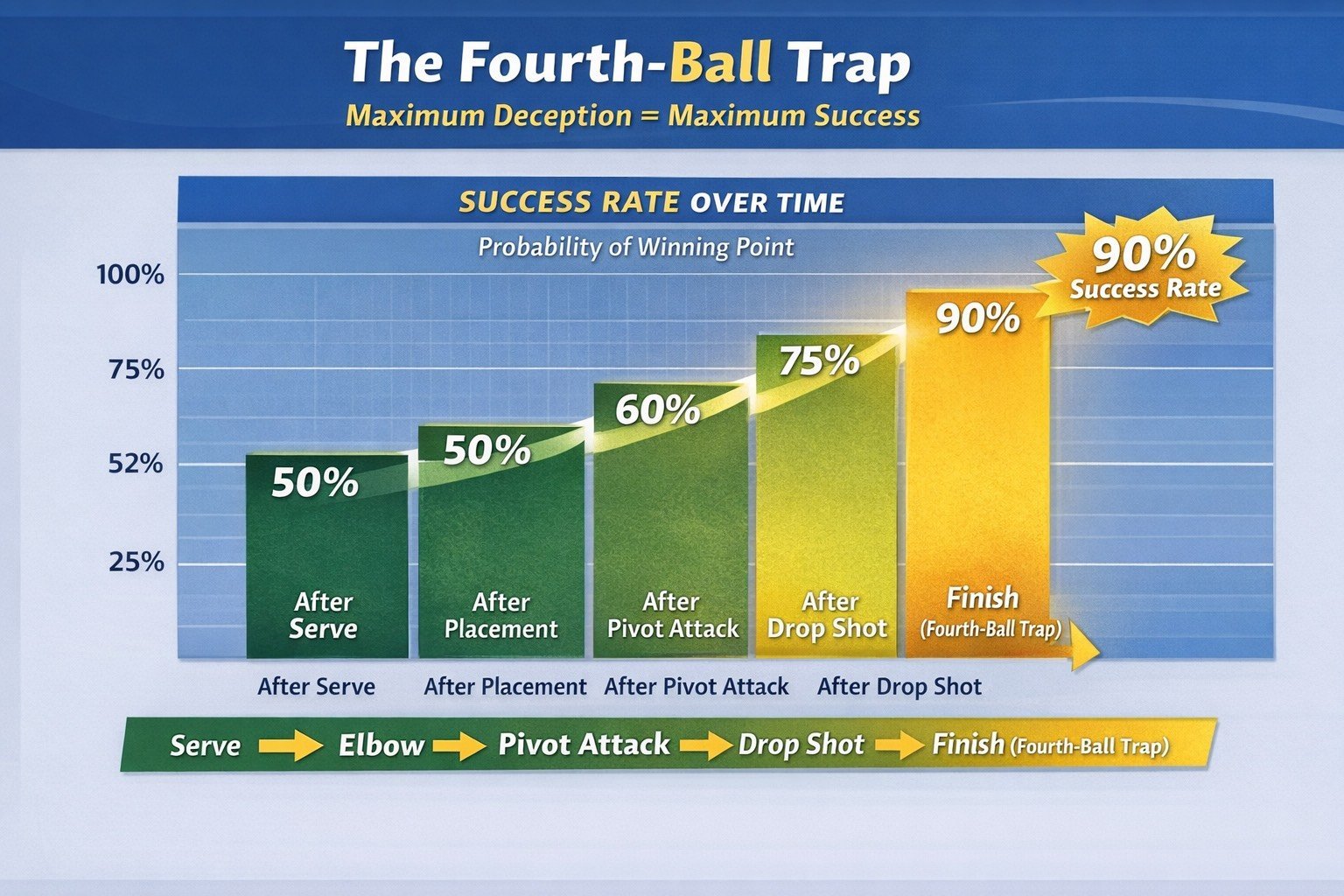
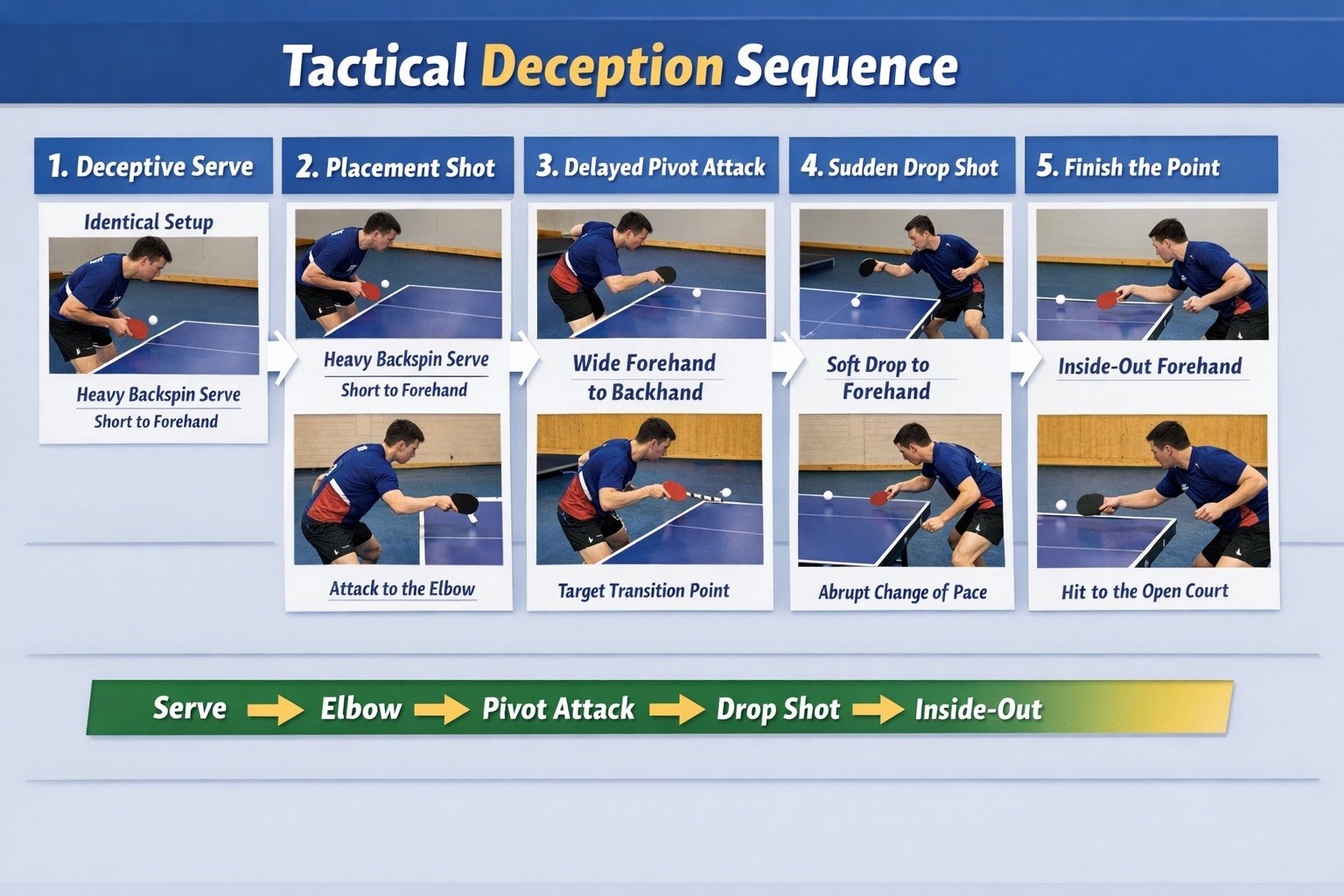
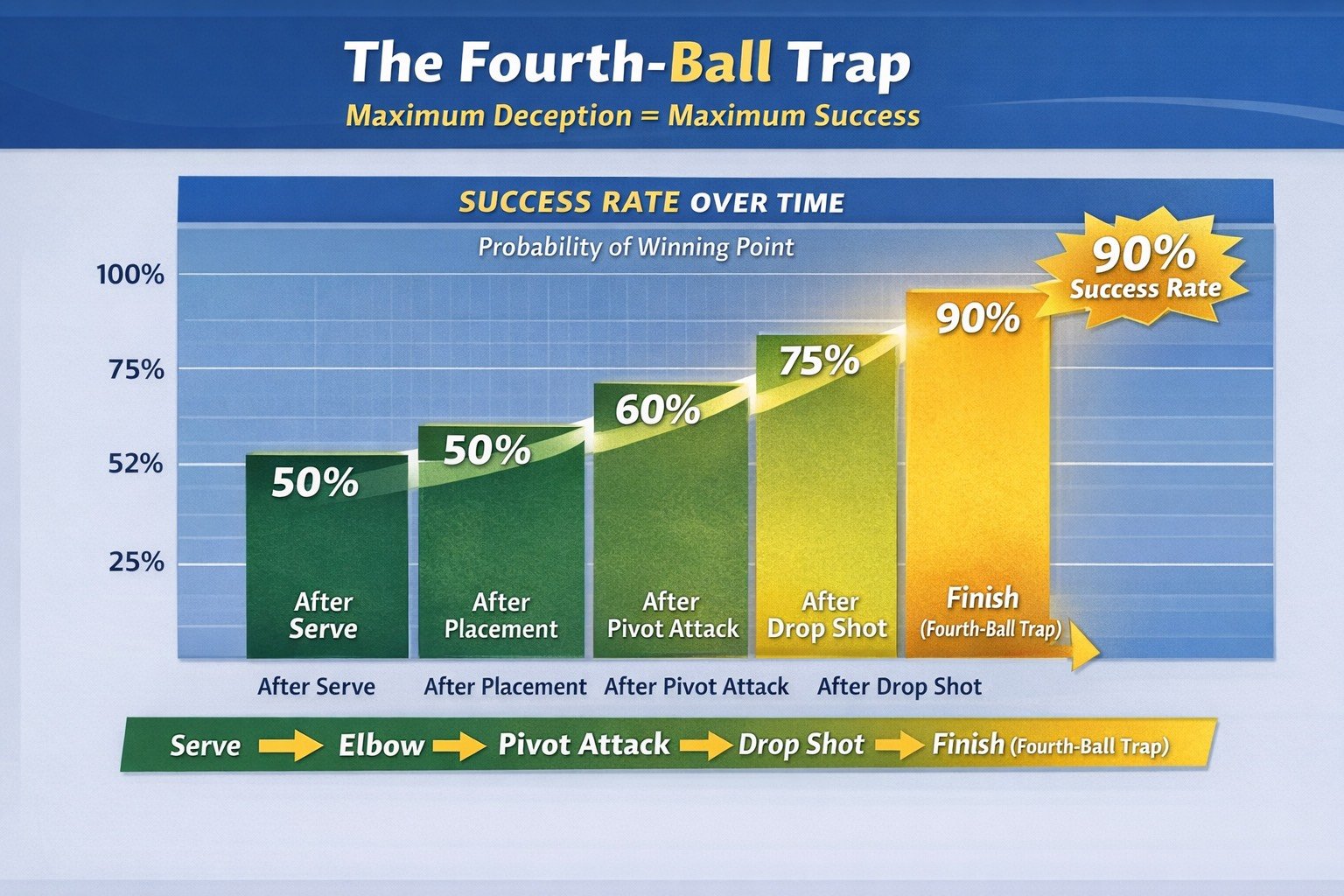
A new, legal tactical play can be designed as a structured sequence that combines deception, forced positioning, and rapid pattern switching, executed as a repeatable “signature play” rather than a single trick. The objective is to manipulate the opponent’s expectations across three consecutive shots and then break the pattern at the fourth.
On the third ball, do not attack immediately. Instead, execute a controlled placement shot to the opponent’s elbow (transition point between forehand and backhand). This is intentional: most players hesitate in this zone. Your goal here is not to win the point, but to freeze the opponent’s positioning and reduce their ability to generate strong angles.
Immediately after this, initiate a delayed pivot attack. Instead of attacking from your current position, take a quick half-step to pivot and play a forehand topspin directed wide to the opponent’s backhand. The delay is critical—it disrupts timing and makes the attack less predictable compared to standard third-ball attacks.
Now comes the defining innovation of the play: instead of continuing with power, switch abruptly to a soft, short placement on the next contact (if the rally continues). This can be a drop shot or very short block close to the net on the forehand side. The opponent, expecting continued speed from your pivot attack, is typically positioned too far back to react quickly.
If the opponent manages to reach the short ball, finish the sequence with an inside-out forehand to the open court, using their forward movement against them. Because they had to step in, their recovery to wide angles will be slower.
To execute this play correctly, follow these exact principles:
-
Use identical serve mechanics for at least two variations (spin vs no-spin)
-
Always place the first attacking ball into the elbow, not the corners
-
Delay your pivot slightly instead of rushing the attack
-
Break the rhythm intentionally by switching from fast to soft
-
Finish by exploiting the opponent’s movement imbalance
This sequence creates a controlled tactical trap: uncertainty on serve, hesitation in positioning, disruption of timing, and finally forced movement in the wrong direction. It is fully legal, relies on skill rather than hidden techniques, and can be trained as a repeatable pattern to give a player a distinctive and difficult-to-read playing style.
Written by juraforge in Ecuador — PINGPONG coverage, published on April 7, 2026.

Leave a Reply