
When people watch a hockey game, they focus on speed, skill, and physical play. From where I stand as a referee, the game looks different. My performance isn’t measured by highlights — it’s measured by how consistent my decisions are over 60 minutes.
In a typical game, I’m involved in 40 to 70 judgment situations. These include stick infractions, body contact, positioning calls, and advantage decisions. Out of those, only about 8 to 15 situations result in penalties. The rest still require evaluation, even if no whistle is blown.
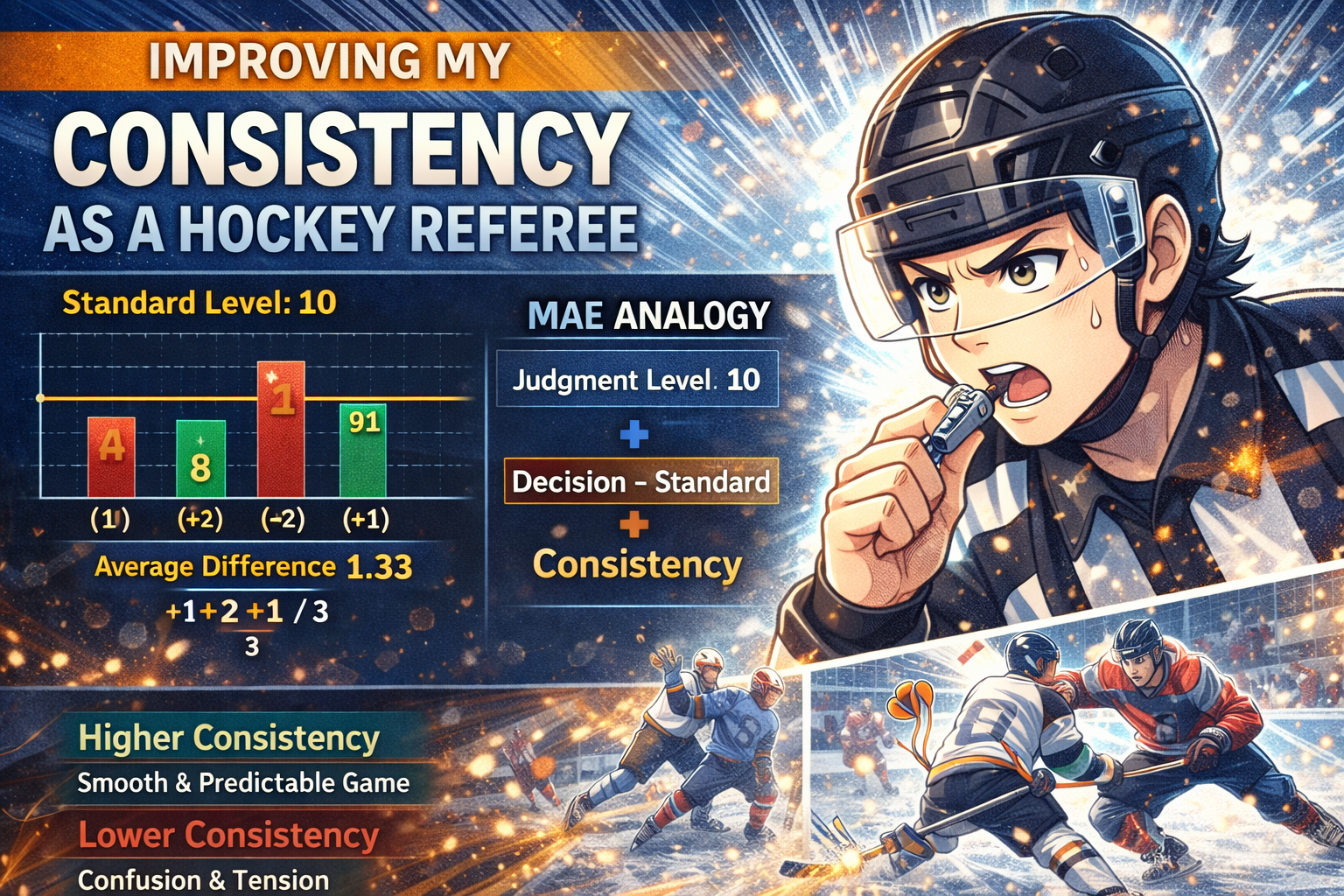
To keep my decisions consistent, I think in terms of average deviation from a standard.
A simple analogy helps explain this.
Imagine I define a “standard call level” for a specific infraction — for example, how much stick contact qualifies as a penalty. Let’s assign that standard a value of 10. During a game, my actual decisions might vary slightly depending on positioning, speed, and angle. For three similar situations, my decisions might look like this:
- Situation 1: Decision level = 11 → difference = 1
- Situation 2: Decision level = 8 → difference = 2
- Situation 3: Decision level = 9 → difference = 1
If I average these differences, I get an average deviation of about 1.33 units.
In practical terms, this means my decisions are close to my intended standard, even if they are not perfectly identical every time.
This is how I approach officiating. I don’t expect to make identical calls in every situation — that’s unrealistic in a fast-moving game. Instead, I aim to keep my decisions within a tight and predictable range.
Players notice this immediately. If my decision variation stays low — for example, within a small margin like the example above — the game feels fair and consistent. But if that variation increases — say differences of 3–5 units — players begin to question the standard, and the game becomes harder to manage.
Positioning plays a major role in this. I aim to maintain a clear sightline on over 90% of key situations. When my positioning is strong, my decisions tend to stay closer to the intended standard. When I’m out of position, the margin of error increases.
Timing is another factor. In many cases, I have less than one second to make a decision. Under that pressure, consistency comes from preparation and repetition. The more similar situations I’ve seen, the more stable my decision-making becomes.
After each game, I review performance with this mindset. I look at:
- Whether similar situations were judged within a narrow range
- How often my positioning affected decision quality
- Where my decision variation was higher than expected
Even improving consistency by 5–10% — reducing the average deviation slightly — can have a noticeable impact on game control.
At higher levels, such as games associated with the National Hockey League, this becomes even more important. The pace is faster, and small inconsistencies can quickly influence momentum.
Ultimately, officiating is not about eliminating all errors. It is about keeping decisions consistently close to a clear standard. By reducing the average difference between what I intend to call and what I actually call, I create a more stable and fair environment for the game.
From my perspective, that is what effective officiating looks like — not perfection, but controlled, measurable consistency over time.
Written by lexcraftor in India — HOCKEY coverage, published on April 11, 2026.

Leave a Reply