
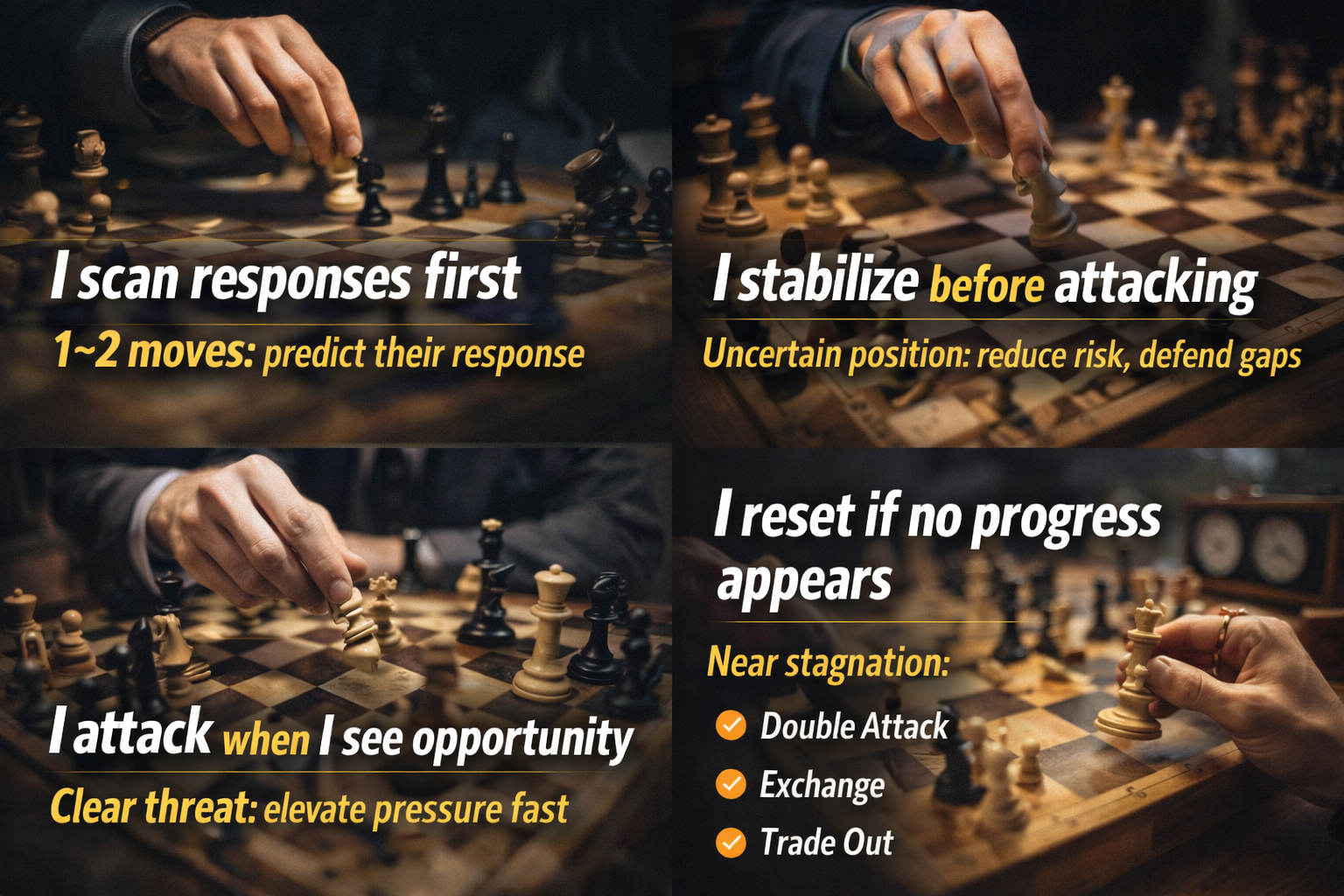
I approach every position with a structured system that keeps my decisions consistent and measurable.
I begin every turn with a scan phase that lasts about 5–10 seconds. During this time, I evaluate 2–3 candidate moves and predict at least one response for each. I check for immediate threats first—checks, captures, and attacks—before thinking about my own plan. If I cannot clearly justify a move within this window, I do not play it.
If the position is unstable—such as exposed king safety, loose pieces, or unclear exchanges—I shift into stabilization. I spend the next 1–2 moves improving piece coordination, defending weaknesses, and reducing risk. My rule is simple: if more than two of my pieces are unprotected or poorly placed, I do not attack. I fix structure before creating pressure.
When I detect a clear advantage—like a material lead, a positional weakness, or a tactical opportunity—I move into execution. I act within 1–2 moves and increase pressure immediately. I limit my calculation to 2–3 move sequences and focus on forcing lines (checks, captures, threats). I avoid unnecessary complexity—if a simple move maintains or increases advantage, I choose it.
If I make 3–5 consecutive moves without improving my position, I reset. I either simplify through exchanges, reposition to a stronger square, or shift the focus of play to another area of the board. I never stay locked into a stagnant plan beyond this threshold.
I also control my decision timing:
- 5–10 seconds → scan and evaluate
- 10–20 seconds → stabilize or prepare
- Immediate (under 5 seconds) → execute clear advantage
- Over 30 seconds → only for critical positions
I track positional balance continuously:
- 0–1 weaknesses → safe to apply pressure
- 2+ weaknesses → stabilize first
- Clear imbalance → convert within 1–2 moves
By following these steps, I maintain a disciplined cycle:
scan → stabilize → execute → reset
This keeps my play efficient, reduces errors, and ensures that every move serves a clear purpose instead of reacting randomly to the position.
Written by lextrix in Japan — CHESS coverage, published on April 11, 2026.

Leave a Reply