
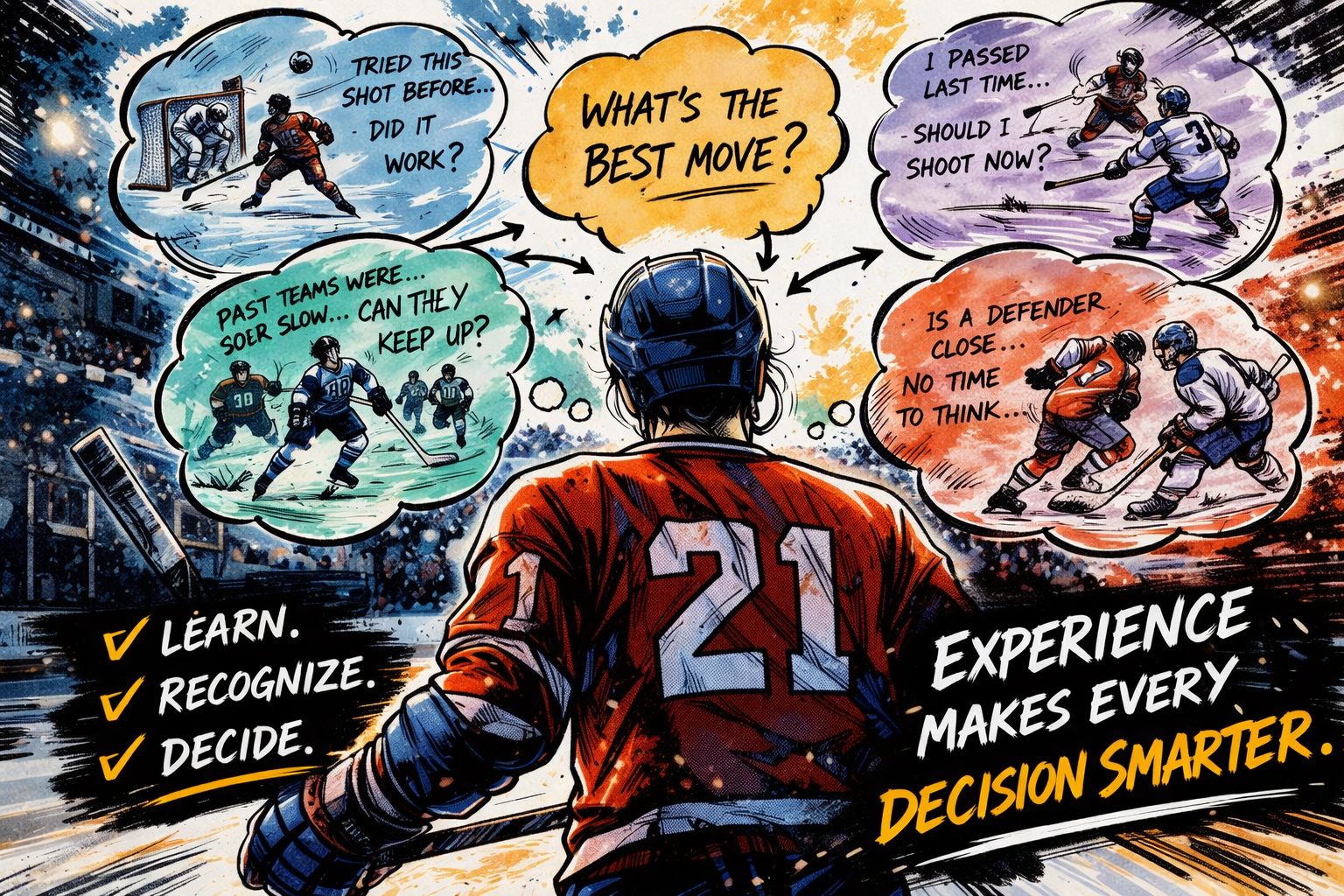
When I started taking hockey more seriously, I realized that my decisions on the ice weren’t random at all. Every pass, shot, or movement I make is influenced by situations I’ve already experienced.
What surprised me most is that I can actually explain my thinking using simple numbers and comparisons.
🧠 How I Read the Game
When I have the puck, everything happens fast. I might be skating toward the goal with defenders closing in, and I instantly have to decide:
- Should I shoot?
- Should I pass?
- Should I hold and reposition?
I don’t consciously calculate, but my brain quickly compares the current situation to similar ones I’ve faced before.
📊 My Mental Scoring System
Over time, I’ve developed a kind of internal scoring system based on past results.
Example:
Let’s say I’m approaching the goal from the right side.
From experience, I might estimate:
- Shooting success in this position: 45%
- Passing to a teammate in front: 65%
- Holding the puck and waiting: 30%
So in my head:
- Shoot → 0.45
- Pass → 0.65
- Wait → 0.30
👉 Passing becomes the best option.
This isn’t something I calculate step by step—it’s something I’ve learned through repetition.
🔍 Comparing Similar Situations
What matters most is how similar the current moment is to past ones.
I quickly evaluate:
- Distance to goal
- Defender positioning
- My speed
- Teammate location
Think of it like this:
Current situation:
- Distance = 8 meters
- Defender gap = 1.5 meters
- Angle = narrow
Past situations:
- Situation A → (7.5, 1.2, narrow)
- Situation B → (10, 2, wide)
👉 Situation A is closer, so I rely more on that memory.
🎯 Using Multiple Past Plays
I don’t rely on just one memory—I consider several similar situations.
Example:
-
Last 5 similar plays:
- 3 successful passes
- 1 successful shot
- 1 turnover
So I estimate:
- Passing success ≈ 60%
- Shooting success ≈ 20%
- Holding ≈ 20%
👉 Again, passing is the safest and smartest move.
⚖️ Where Things Can Go Wrong
Even though this approach works well, I’ve noticed it’s not perfect. There are a few common problems.
1. Relying on Too Few Experiences (Underthinking)
If I only remember one or two past situations, I might make a bad decision.
Example:
- I scored once from a tough angle
- So I try it again—even though it rarely works
👉 This leads to poor judgment because I’m using too little information.
2. Relying on Too Many Situations (Overthinking)
On the other hand, if I try to consider too many past plays:
- I hesitate
- I slow down
- I lose the moment
In hockey, hesitation often means losing the puck.
3. Irrelevant Comparisons
Sometimes I compare the wrong situations.
Example:
- A play from a slow game
- Compared to a fast break situation
Even if they look similar, the context is different.
👉 This can lead to inaccurate decisions.
4. Scale of the Situation Matters
Not all factors are equally important.
For example:
- Defender distance matters more than rink position
- Speed matters more than angle in some plays
If I treat everything equally, I might misjudge the situation.
⚡ Speed Through Practice
Hockey is fast—there’s no time to think deeply during a play.
That’s why repetition is everything.
The more I practice:
- The faster I recognize patterns
- The quicker I estimate outcomes
- The more accurate my decisions become
Eventually, these “calculations” feel automatic.
🔍 Recognizing Patterns
Over time, I’ve started seeing patterns clearly:
- Certain defenders always pressure aggressively
- Some passing lanes open consistently
- Specific positions lead to higher scoring chances
These patterns shape my decisions without me needing to consciously think about them.
🎯 Final Thoughts
For me, hockey is not just about speed and skill—it’s about making smart decisions based on experience and quick comparisons.
Every time I play, I’m:
- Matching the current situation to past ones
- Estimating what works best
- Choosing the option with the highest chance of success
I’m not just reacting on the ice—I’m constantly learning, adjusting, and improving with every play.
Written by lextrix in Belgium — HOCKEY coverage, published on April 18, 2026.

Leave a Reply