
Well-crafted plays are often associated with meticulous planning and detailed analysis. At the highest levels, teams rely on advanced tools to track movement, measure spacing, and refine every phase of play. But strong, effective patterns can also be developed without perfect data.
In many cases, the foundation for good play design already exists in standard match footage. The key lies in how that information is interpreted and applied.
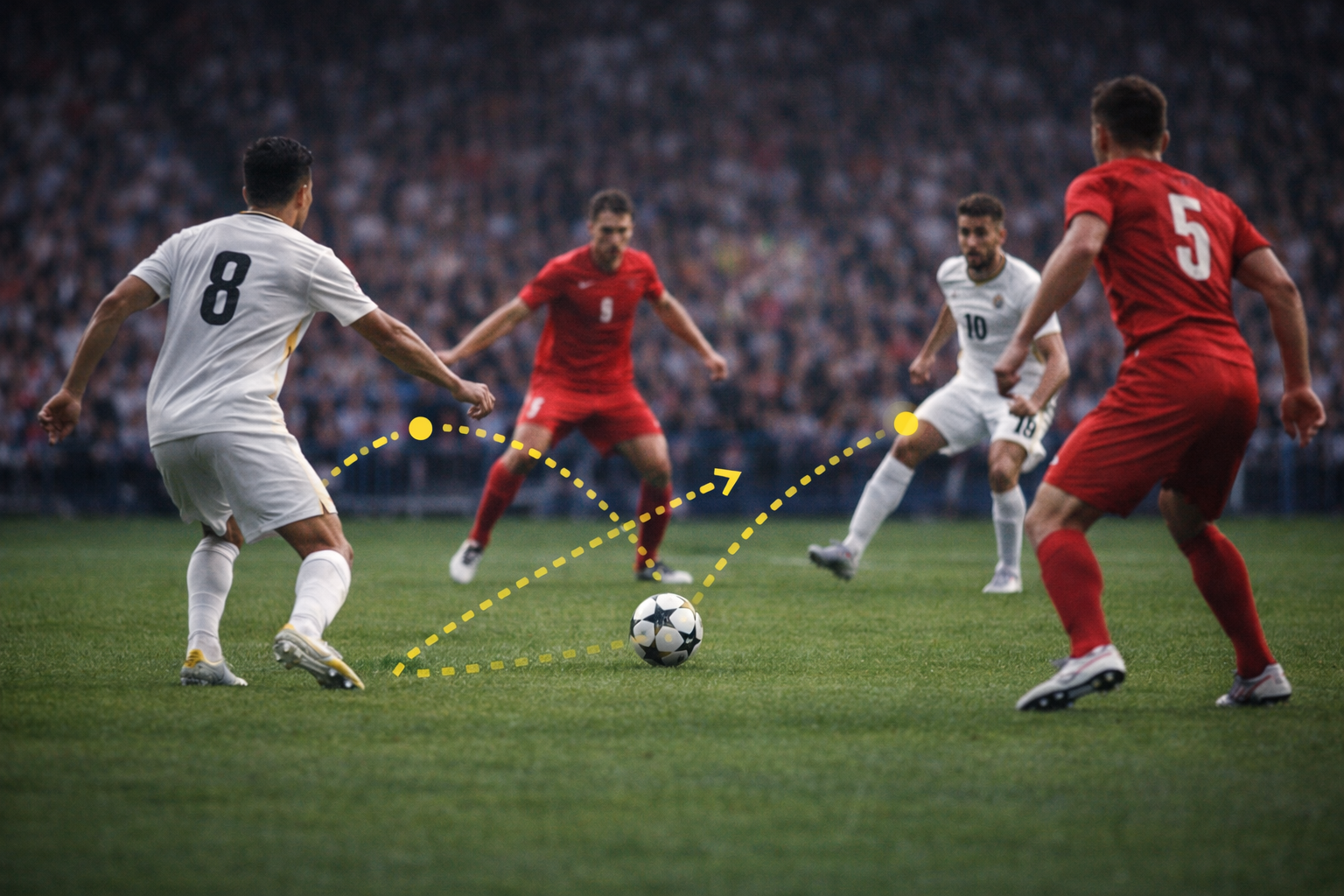
From Observation to Action
Every match offers repeated patterns—runs into space, defensive shifts, passing sequences—that can be studied and refined.
Even without precise measurements, coaches can identify:
- Where space tends to appear
- How players react under pressure
- Which movements consistently create advantage
These observations may not be exact, but they are consistent enough to shape reliable plays.
Building Plays from Approximate Patterns
Instead of designing plays around exact positioning, effective teams focus on relationships:
- The distance between lines
- The timing of overlapping runs
- The angles of support around the ball
By working with these relative ideas, teams create plays that remain functional even when the situation is not ideal.
For example:
- A wide player doesn’t need a fixed position, only the right moment to stretch the defense
- A midfielder doesn’t need a marked spot, only the correct angle to receive and turn
- A forward doesn’t need a scripted run, only the cue that triggers movement behind the line
Adapting Proven Structures
Many successful plays are built on familiar patterns—switching play, third-man runs, quick combinations around the box.
What matters is not reinventing these patterns, but refining them using what can be consistently observed. By studying real match situations, teams can adjust timing, spacing, and decision-making within these established structures.
This allows players to execute plays naturally, rather than forcing rigid sequences.
Strength Under Difficult Conditions
One of the true tests of any play is how it performs when conditions are less than ideal—poor visibility, high pressure, or chaotic transitions.
Plays built from flexible principles rather than exact instructions tend to hold up better in these moments. Players are guided by understanding rather than memorization, allowing them to adapt without losing structure.
This leads to:
- Better decision-making under pressure
- More fluid attacking movement
- Greater consistency across different match scenarios
Continuous Refinement
Effective play design is not a one-time process. It evolves through repeated observation and adjustment.
By continually reviewing matches and identifying what works—even imperfectly—teams can refine their plays over time. Small improvements in timing, positioning, or support can significantly increase overall effectiveness.
Final Thought
The best plays are not always the most complex or precisely measured. They are the ones players understand, trust, and can execute under any condition.
By focusing on patterns, relationships, and timing—rather than perfect data—teams can build attacking and defensive plays that are both practical and resilient.
Written by juridex in Canada — SOCCER coverage, published on April 5, 2026.

Leave a Reply