
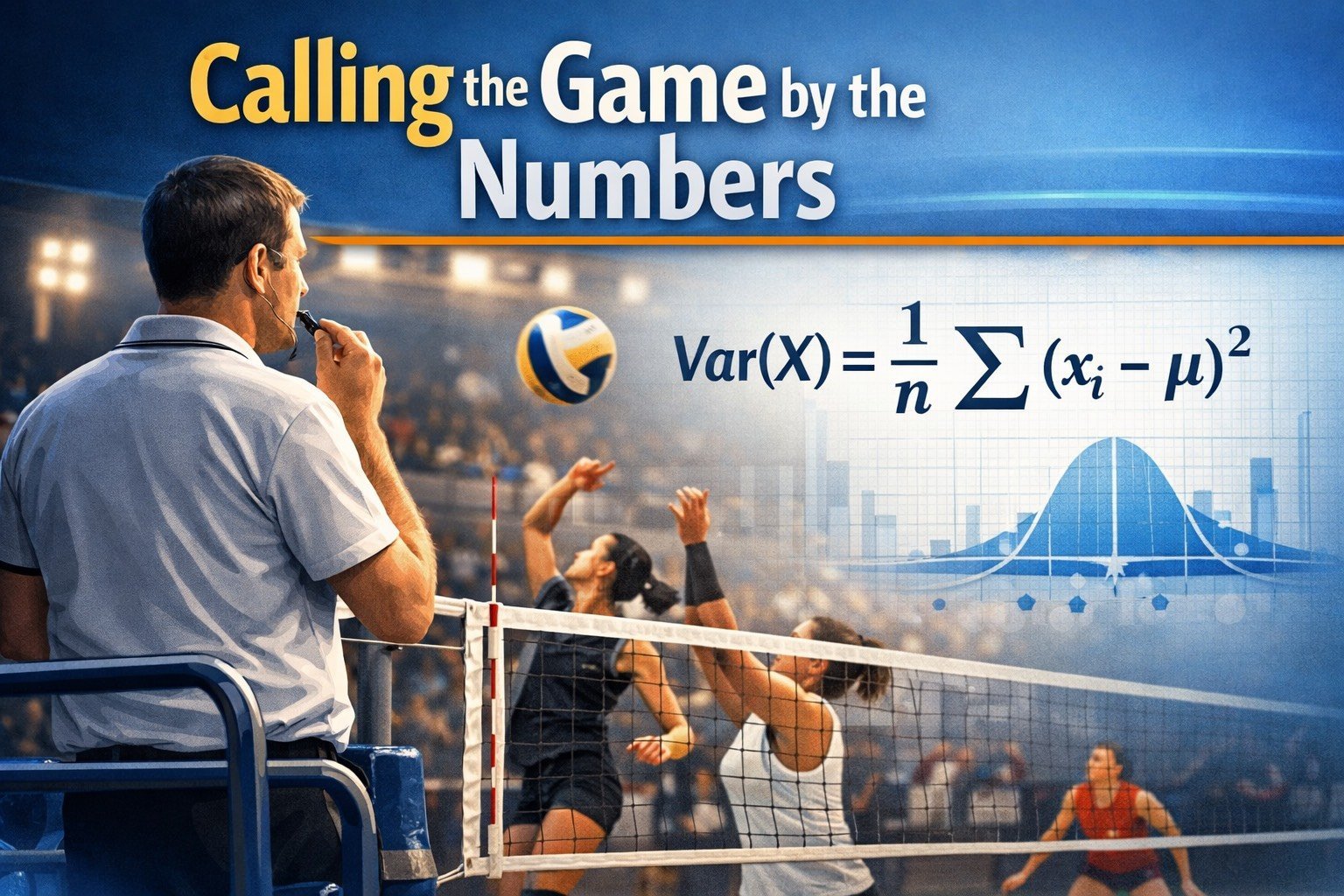
From my stand above the net, every rally feels like a dataset unfolding in real time. I’m not holding a calculator, but my mind works in a structured, almost quantitative way. If I had to translate my role into math, it would center on one idea: variance—how far each play deviates from what’s expected.
In statistics, variance is written as:
Standing on the platform, I don’t see symbols—I see actions. But the logic is the same.
-
mu (the mean) → the ideal play: clean contact, legal positioning, no faults
-
x_i → each actual action on the court: a serve, a block, a dig
-
Deviation (x_i – mu) → how far that action strays from the rulebook standard
-
Squared deviation → the impact of that mistake or irregularity
Every rally is a sequence of these “data points.” My job is to evaluate them instantly.
Reading the Rally Like a Dataset
A perfect set followed by a clean spike? That’s a data point very close to the mean—low deviation, low concern.
But then comes a tight net play. Hands press over, the ball ricochets, and for a fraction of a second, everything is uncertain. That’s a high-deviation event. In variance terms, it carries more weight. My eyes lock in, because those are the moments that define outcomes.
Over the course of a match, I’m subconsciously aggregating:
-
How often players approach the edge of legality
-
How frequently borderline contacts occur
-
Whether a team consistently operates near high deviation zones
It’s not about numbers on paper—it’s pattern recognition shaped like a formula.
Managing High-Variance Moments
Not all plays are equal. In the variance formula, extreme values matter more because they’re squared. The same applies on the court.
A slightly off-center pass? Minimal impact.
A potential net violation during a game point? That’s a squared deviation—high stakes, high attention.
In those moments, I slow everything down mentally. My training kicks in like a model designed to handle outliers. I rely on positioning, angles, and experience to reduce uncertainty and make the most accurate call possible.
Consistency as a Constant
If the players are the variables, I must be the constant. My decisions form the baseline against which all variability is judged.
If I start calling similar plays differently, I’m effectively increasing the variance of officiating—and that disrupts the entire system. Players lose trust, rhythm breaks, and the match drifts away from fairness.
So I aim to minimize my own “error term.” Every whistle, every signal is part of maintaining a stable mean.
The Flow of the Match
Over time, the game develops its own statistical personality.
Some matches are low-variance: clean rallies, disciplined teams, predictable flow. Others are chaotic—full of unpredictable touches, emotional swings, and constant edge cases.
From my vantage point, I adapt continuously. I’m not just observing—I’m calibrating. Each rally updates my internal model, helping me anticipate where the next deviation might occur.
Final Reflection
Refereeing volleyball isn’t just about enforcing rules—it’s about interpreting variation under pressure. Every point is a new sample. Every decision is a judgment of deviation.
Written by axiomera in Colombia — VOLLEYBALL coverage, published on April 14, 2026.

Leave a Reply