
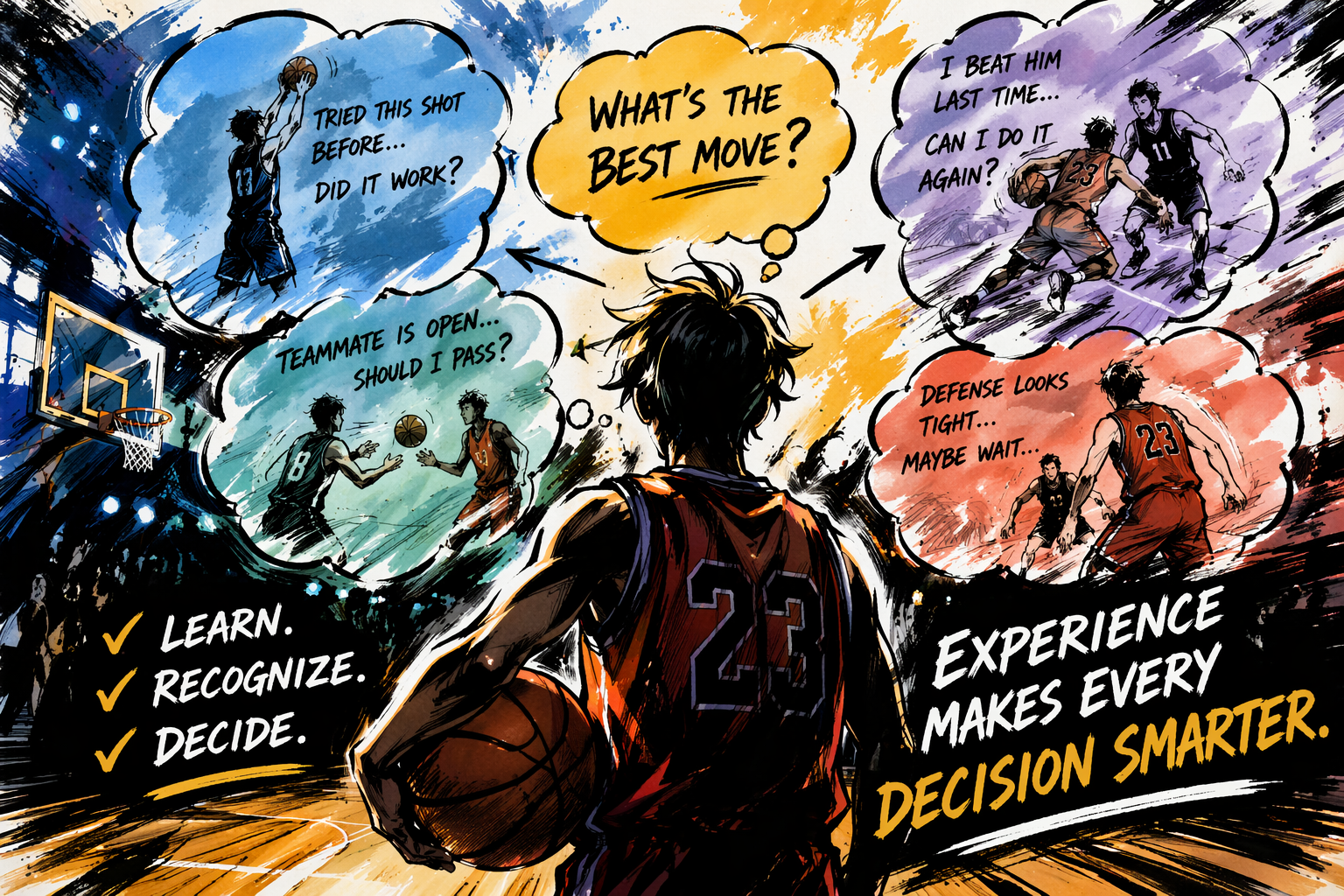
When I started analyzing how I play basketball, I realized something deeper than just instinct. Every move I make—whether I shoot, pass, or drive—is influenced not only by experience but also by a kind of quick mental calculation.
I don’t just react randomly. I compare the current situation with similar ones I’ve faced before and choose what has the highest chance of working.
🧠 My Personal “Decision Formula”
Over time, I began to think of my decisions almost like a scoring system.
Let’s say I’m holding the ball near the three-point line. I have three options:
- Shoot
- Pass
- Drive
Instead of guessing, my mind evaluates each option using past situations.
Example (how I think numerically):
From memory, I might estimate:
- Shooting success rate in this situation: 60%
- Passing success (teammate scores): 75%
- Driving success (getting past defender): 50%
Now I mentally compare:
- Shoot → 0.60
- Pass → 0.75
- Drive → 0.50
👉 The highest value wins → I pass.
I don’t consciously calculate like a computer, but my brain has learned these probabilities through repetition.
📊 How I Compare Similar Situations
What really matters is how similar the current situation is to past ones.
I quickly evaluate factors like:
- Distance from the basket
- Defender pressure
- My position on the court
- Teammate positioning
Then I “measure” how close this situation is to previous ones.
Simple way to think about it:
If I imagine each situation as numbers:
- Distance to basket = 6 meters
- Defender distance = 1 meter
- Angle = 30 degrees
I compare it to past situations like:
- Situation A → (5.5, 1.2, 25)
- Situation B → (7, 0.8, 40)
The closer the numbers, the more relevant the experience.
So I rely more on situations that are “closer” to the current one.
🎯 Using Multiple Past Experiences
I don’t rely on just one memory. I look at several similar situations.
For example:
-
Last 5 similar plays:
- 3 successful passes
- 1 successful shot
- 1 failed drive
So I think:
- Passing worked 3 out of 5 times → 60%
- Shooting worked 1 out of 5 times → 20%
- Driving worked 1 out of 5 times → 20%
👉 Again, passing is the best option.
⚖️ Why Balance Matters
If I only look at one past experience, I might make a bad decision.
But if I try to remember too many situations, I slow down.
So I naturally focus on a small group of the most similar experiences—just enough to guide me without overthinking.
⚡ Speed and Practice
Basketball is fast. I don’t have time to do real calculations during a game.
That’s why practice is essential.
The more I repeat situations:
- The faster I recognize patterns
- The quicker I estimate outcomes
- The more accurate my decisions become
Eventually, these “calculations” feel automatic.
🔍 Patterns Behind the Numbers
As I gained experience, I started noticing patterns:
- Close defenders reduce shooting success
- Open teammates increase scoring chances
- Certain angles improve shot accuracy
These patterns shape the numbers in my head and make my decisions smarter over time.
🎯 Final Thoughts
For me, basketball is not just instinct—it’s experience combined with quick mental comparisons.
Every time I make a decision, I’m:
- Comparing similar past situations
- Estimating success rates
- Choosing the best option based on those estimates
I’m not just playing the game—I’m constantly calculating, learning, and improving with every move.
Written by normatrix in South Africa — BASKETBALL coverage, published on April 18, 2026.
Leave a Reply