
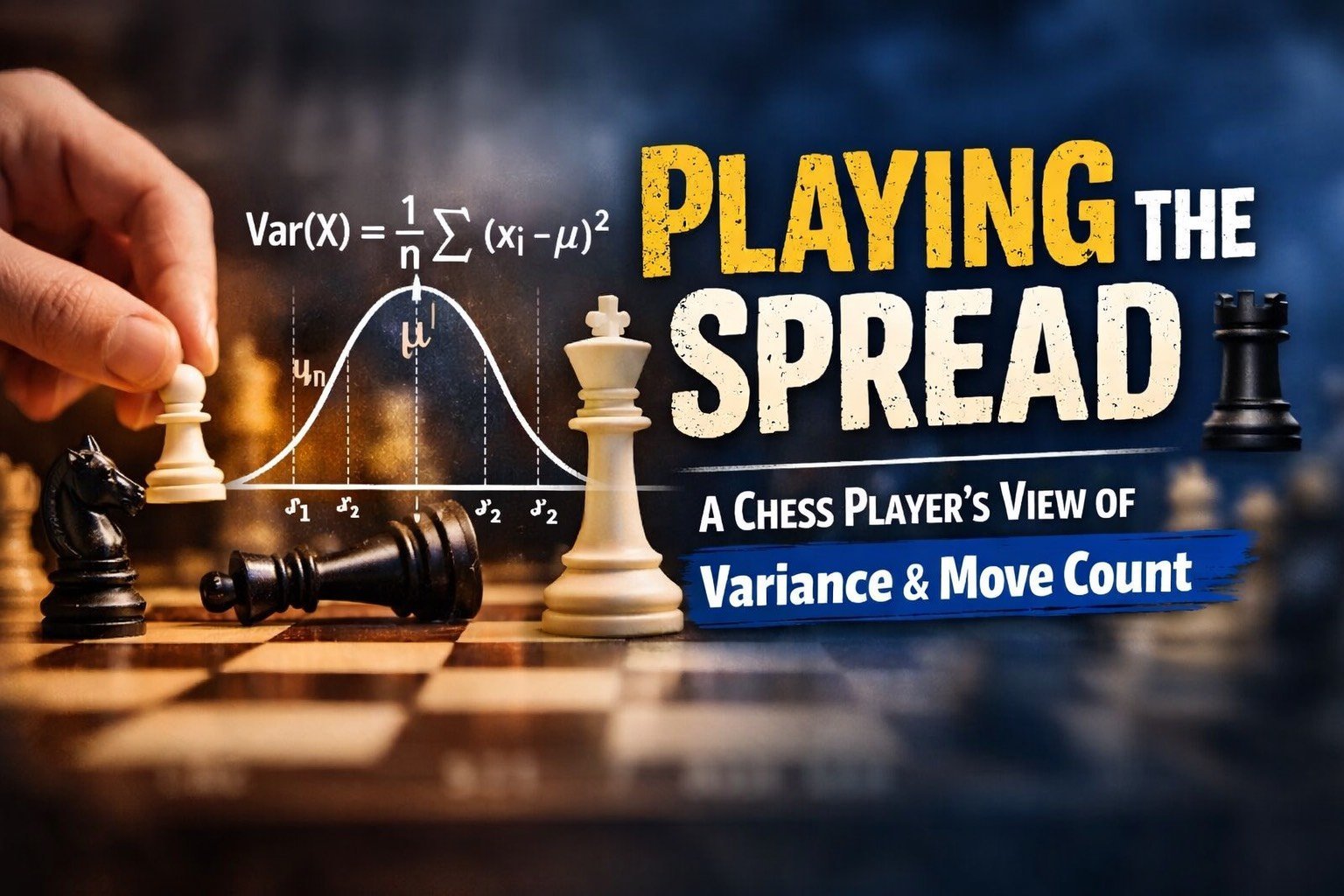
Sitting across the board, I don’t just see pieces—I see a sequence of decisions—each one a data point. A typical chess game lasts 30 to 60 moves per player (that’s 60–120 total moves), and every move contributes to the game’s variance.
Mathematically, it feels like:
Where:
-
n = total moves (often 40–60 per side)
-
x_i = my move
-
mu = the best possible move
♟️ How Move Count Affects Variance
-
Opening (Moves 1–15): Low variance, theory-driven
-
Middlegame (Moves 15–40): High variance, most decisive mistakes
-
Endgame (40+): Lower variance, but errors are critical
👉 Just 2–3 big mistakes in a 40-move game can outweigh dozens of good moves.
📊 Why Big Mistakes Matter Most
Because deviations are squared, a single blunder dominates:
-
Many small inaccuracies → manageable
-
One major blunder → game-changing
👉 Chess isn’t lost by average play—it’s lost by outliers.
🤖 Fun Facts: The Smartest Chess AIs
-
♟️ Stockfish evaluates millions of positions per second and is one of the strongest engines ever created.
-
🧠 AlphaZero learned chess from scratch in just hours, by playing against itself—no human data needed.
-
⚡ AlphaZero shocked the world by defeating Stockfish in a famous match with a creative, human-like style.
-
🔍 Modern engines don’t just calculate—they evaluate probability and long-term positional strength, reducing variance in decision-making.
-
📈 Top engines operate so close to the “mean” (perfect play) that their variance is extremely low compared to humans.
🎯 First-Person Reflection
From my perspective, every move adds to a distribution I’m shaping in real time.
Across 40–50 moves, I’m not chasing perfection—I’m minimizing deviation. Keeping my play consistent, controlled, and within a tight range of optimal decisions.
Because I know:
👉 The game isn’t decided by the average move
👉 It’s decided by the biggest deviation
And sometimes, just one move—out of fifty—is all it takes.
Written by legionorm in Bangladesh — CHESS coverage, published on April 14, 2026.

Leave a Reply