
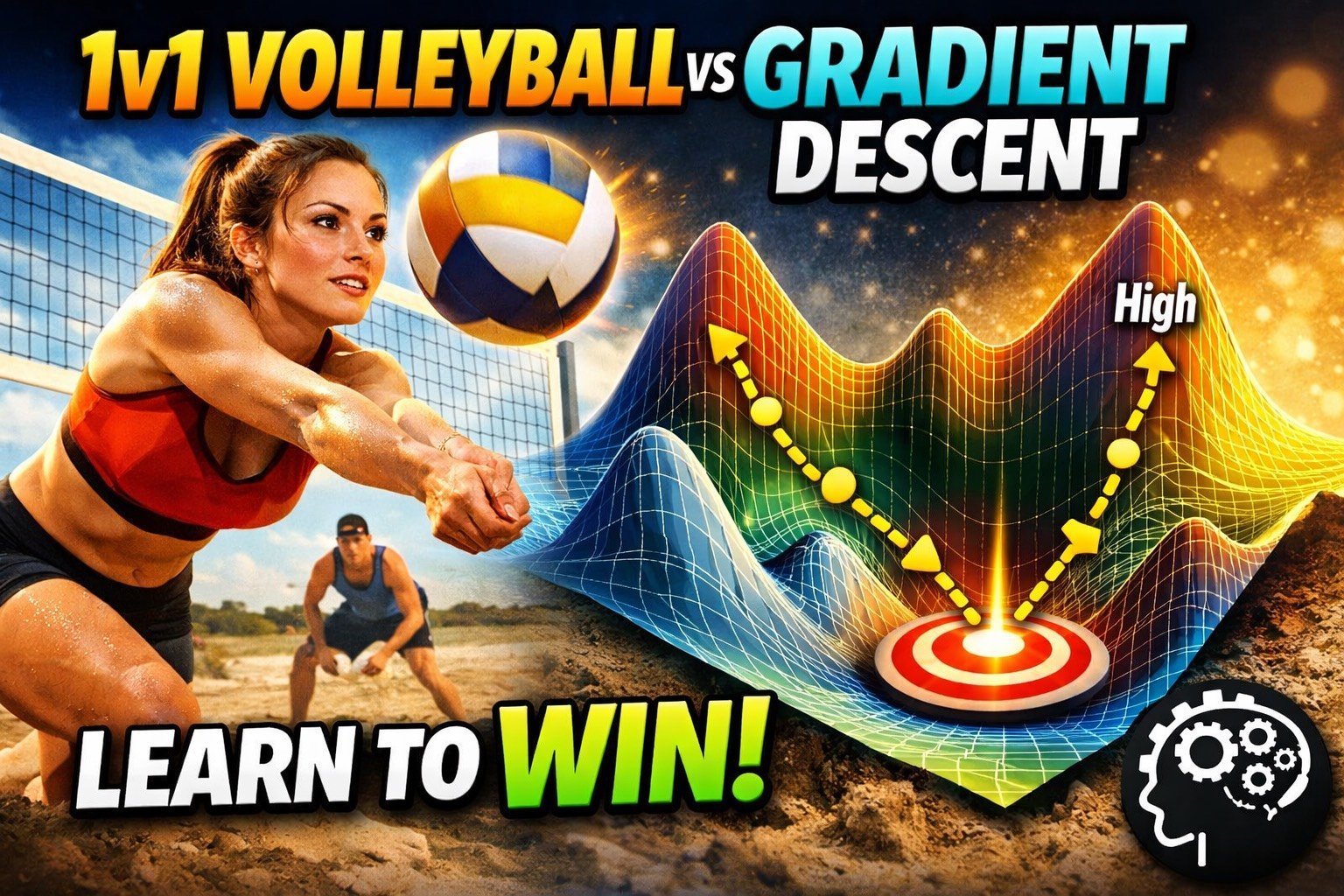
Imagine the entire volleyball court as a landscape filled with hills and valleys.
-
The lowest valley = the perfect winning play (a shot your opponent cannot return).
-
The high points = bad decisions (easy balls your opponent crushes back).
Every time you hit the ball, you’re choosing a direction on this landscape.
🎯 Each Shot = A Step in Gradient Descent
In gradient descent, you don’t magically jump to the best solution—you take small, informed steps based on feedback.
In 1v1 volleyball:
-
You hit cross-court → opponent returns easily → that direction was “uphill.”
-
Next rally, you try a softer drop shot → opponent barely reaches → you’re moving “downhill.”
Each rally gives you feedback (the gradient):
-
Did that shot improve your position?
-
Did it make your opponent struggle more?
So you adjust.
🔁 Iteration: Learning Within the Match
Gradient descent is iterative—and so is volleyball.
You start noticing patterns:
-
Your opponent struggles with deep corners
-
They’re slow to react to short drop shots
So you keep updating your “strategy parameters”:
-
Hit deeper
-
Mix in drops
-
Change angles slightly each time
Just like tuning weights in a model, you’re refining your play style point by point.
⚖️ Learning Rate = How Aggressive You Play
In optimization, the learning rate controls step size.
In volleyball:
-
High learning rate → big risks (hard spikes, sharp angles)
-
Can win fast… or lose fast.
-
-
Low learning rate → safe plays (consistent returns)
-
Slower progress, but more stable.
-
Great players constantly adjust:
-
Losing? Increase aggression.
-
Winning? Play safer and control rallies.
🧠 Local Minima: Getting Stuck in Patterns
Sometimes, you find a strategy that works… but not perfectly.
Example:
-
You keep hitting to the backhand side and winning points.
-
But a better strategy exists (e.g., mixing shots), and you’re not exploring it.
That’s like being stuck in a local minimum:
-
It’s “good enough,” but not optimal.
To escape:
-
Try something new (a risky serve, a different angle)
-
Force exploration
🎲 Stochastic Gradient Descent = Unpredictability
Real matches aren’t perfectly predictable.
-
Wind, fatigue, reaction time → randomness
-
Your opponent adapts
This is like stochastic gradient descent (SGD):
-
You’re updating based on noisy, imperfect feedback
That’s why variation matters:
-
Mix power with finesse
-
Change tempo
-
Keep your opponent guessing
🏆 Convergence: Finding Your Winning Strategy
As the match goes on:
-
You learn what works
-
You refine your shots
-
You reduce mistakes
Eventually, your play “converges”:
-
You consistently exploit weaknesses
-
Your opponent struggles to respond
That’s your optimized strategy—the “minimum” you’ve been searching for.
💡 Final Takeaway
1v1 volleyball is like running gradient descent in real time:
-
Every rally = new data
-
Every shot = a parameter update
-
Every mistake = useful feedback
The best players aren’t just athletic—they’re constantly optimizing, adjusting their strategy step by step until they find the winning formula.
Written by ruleforge_x in Chile — VOLLEYBALL coverage, published on April 12, 2026.

Leave a Reply