
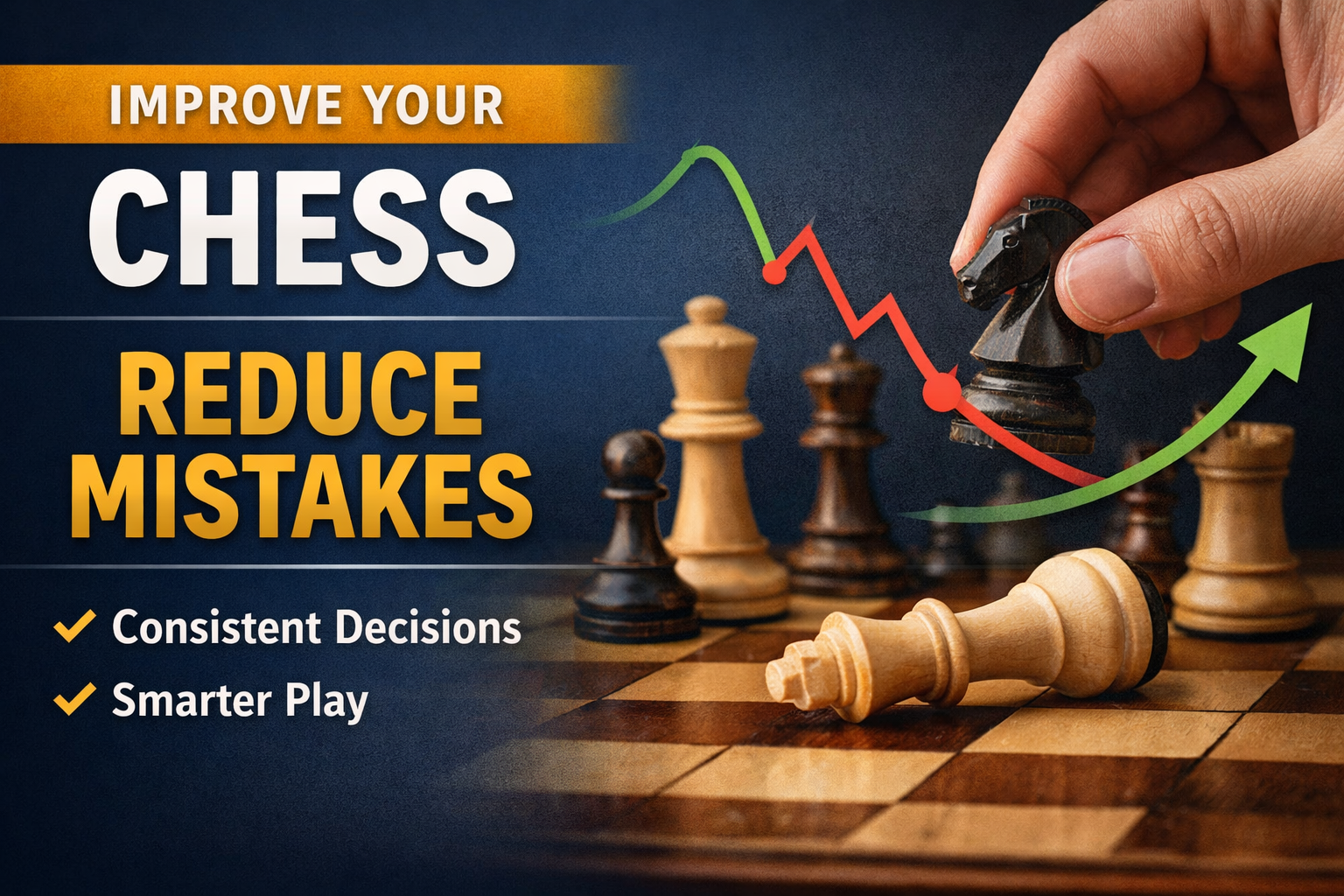
In competitive chess, the difference between strong and average players is rarely a single brilliant move. More often, it comes down to how consistently a player avoids small mistakes throughout the game. While spectacular tactics attract attention, long-term success is built on disciplined decision-making.
A useful way to approach improvement is by focusing on decision accuracy over time. In a typical game, a player may make 30 to 60 meaningful decisions. Even a small drop in quality across just 5–10 of those moves can significantly impact the final result. The goal is not to find perfection on every move, but to remain consistently close to the strongest choices available.
In practical terms, this means prioritizing reliable and stable moves over risky or overly complex ideas. For example, in a balanced middlegame, there may be 2–3 solid continuations. Choosing one that improves piece coordination, maintains structure, and limits counterplay often leads to better outcomes than selecting a high-risk line with uncertain rewards.
This mindset becomes even more important in longer games. Small inaccuracies — such as weakening pawn structure, misplacing a piece, or overlooking a simple improvement — can accumulate over time. A single minor inaccuracy might only shift the evaluation slightly, but repeating this 6–8 times in a game can create a decisive disadvantage.
Improvement, therefore, should not focus solely on tactics. It should also include evaluating the quality of decisions made during a game. After each match, players can review key moments and consider:
-
Was there a more stable alternative within the top 2–3 choices?
-
Did this move introduce unnecessary risk compared to safer options?
-
How did this decision influence the position over the next 3–5 moves?
By consistently reflecting on these questions, patterns begin to emerge. Many players find that reducing just 10–20% of their recurring mistakes leads to noticeable improvements in results and rating over time.
Modern analysis tools can assist by highlighting where decisions could have been more precise. Even small differences in evaluation — for example, choosing a move that is slightly inferior — can compound across a game if repeated multiple times.
Ultimately, strong chess is not about avoiding every mistake — that is unrealistic. It is about reducing the frequency and impact of errors. Players who maintain steady and accurate play across dozens of decisions are far more likely to convert advantages and resist pressure.
In competitive settings, consistency often outperforms brilliance. By focusing on sound decisions and minimizing unnecessary risks, players build a foundation for sustained progress and long-term success.
Written by statcore in Bhutan — CHESS coverage, published on April 11, 2026.

Leave a Reply