
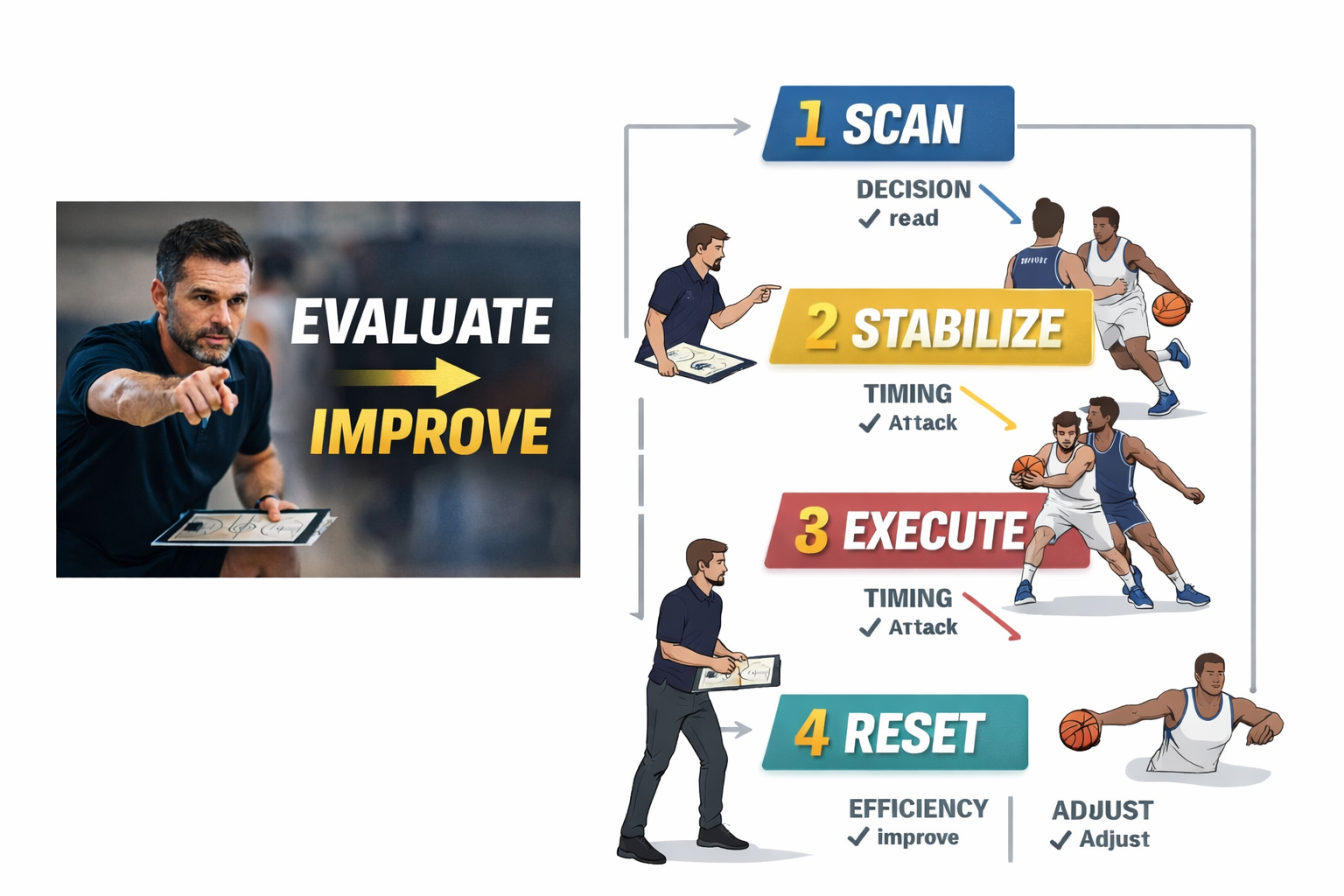
As a coach, I don’t judge players only by whether they score or miss. I evaluate how close their decisions are to the right decision in each situation. Over the course of a game, small decision errors add up and directly impact performance.
Instead of guessing, I use simple measurable standards to track and improve how my players think on the court.
Step 1: Define the Right Decision in Each Situation
Before I can evaluate a player, I clearly define what the correct action looks like.
For example:
- Open shot with more than 2 steps of space → shoot within 1 second
- Defender within arm’s reach → protect or pass
- Double team arrives → pass immediately within 1–2 seconds
This gives players a clear reference. Without this, they rely on instinct, which leads to inconsistency.
The goal is simple: reduce the gap between what they do and what they should do.
Step 2: Track Decision Accuracy Over Multiple Possessions
I don’t evaluate a single play. I look at patterns across 10–15 possessions.
Typical breakdown:
- 60–70% correct decisions → solid performance
- 80%+ correct decisions → high-level play
- Below 50% → needs immediate correction
For example, if a player makes the right decision 7 out of 10 times, that’s acceptable. But if they consistently drop below that, it becomes a problem.
This approach removes emotional judgment and replaces it with measurable performance.
Step 3: Identify the Type of Mistake
Not all mistakes are the same. I categorize them so players understand what to fix.
1. Timing Issues
- Acting too late (holding the ball too long)
- Missing the window to shoot or drive
Target correction:
- decision within 1 second when open
2. Selection Errors
- Taking contested shots unnecessarily
- Forcing drives into traffic
Target correction:
- limit risky decisions to less than 20% of possessions
3. Awareness Gaps
- Missing open teammates
- Not recognizing defensive positioning
Target correction:
- identify at least 2 passing options before acting
Step 4: Apply Immediate Corrections
Once I identify the issue, I apply clear rules during practice and games.
Examples:
- “1-second rule” for open shots
- maximum of 3 dribbles before making a decision
- mandatory pass when double-teamed
These constraints help players build discipline and improve decision speed.
Real Game Example
A player receives the ball on the wing with space:
- holds the ball for 2–3 seconds
- defender closes out
- forced shot → miss
From a results perspective: missed shot
From a coaching perspective: delayed decision
Correct action:
- shoot immediately within 1 second
Fixing timing alone can significantly improve efficiency without changing skill level.
Why This System Works
Most players focus only on outcomes:
- scoring
- missing
- turnovers
But performance is built on decisions.
By measuring:
- how fast they act
- how often they choose correctly
- how consistently they avoid mistakes
I help players improve their overall game, not just isolated plays.
Common Mistake I See
Players either:
- rush under pressure
- or hesitate when they’re open
Both lead to poor outcomes.
The solution is balance:
- slow down when pressured
- act quickly when there’s an advantage
Final Insight
Basketball is a decision-making game played at high speed.
When players understand:
- what the right decision is
- how fast to make it
- and how often they execute correctly
they become more efficient and more reliable.
Over time, even a small improvement—like increasing correct decisions from 60% to 75%—can completely change a player’s impact on the game.
Written by regulyn in Libya — BASKETBALL coverage, published on April 11, 2026.

Leave a Reply