
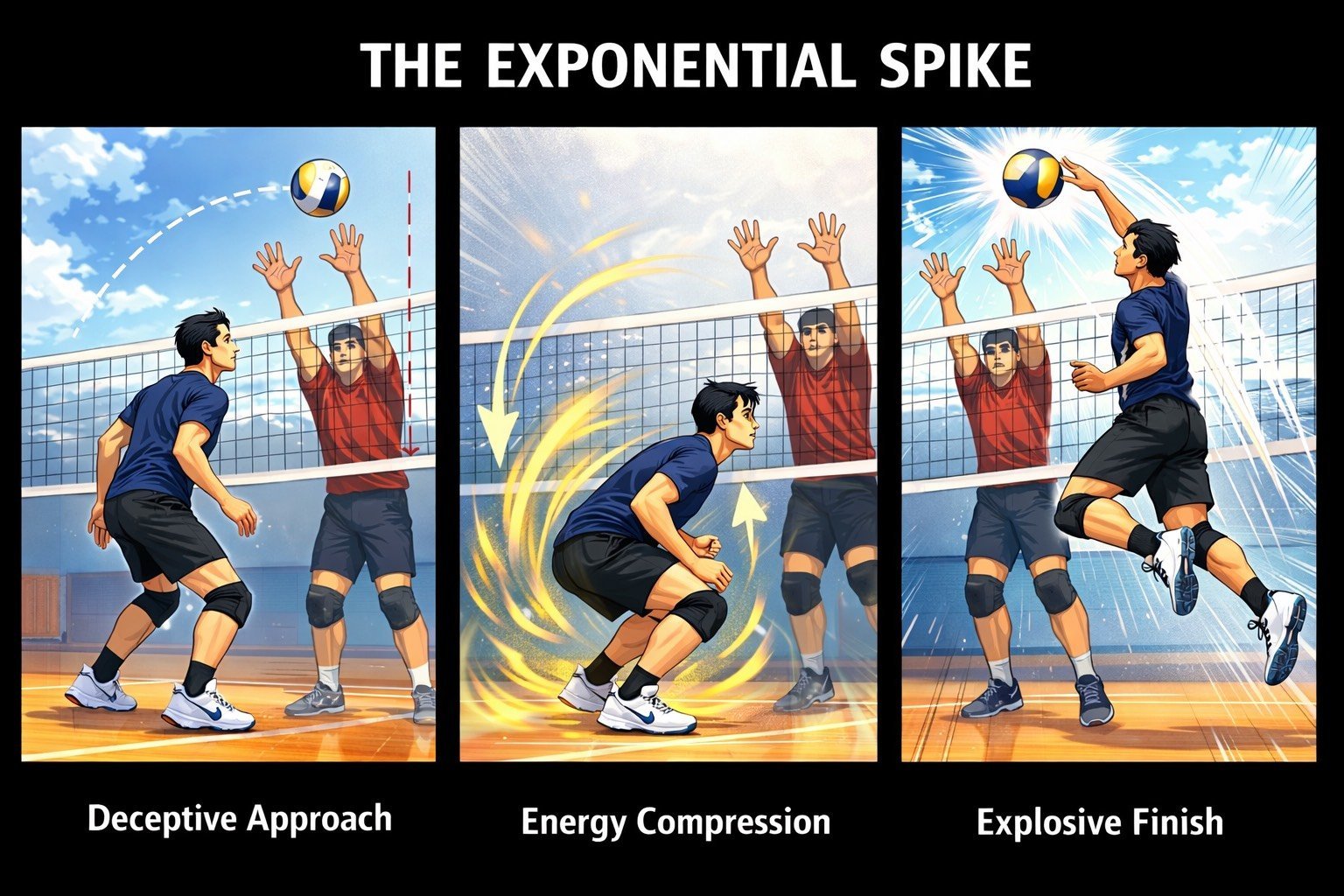
Exponential Spike, a technique that leverages timing asymmetry to disrupt blockers and defenders.
At its core, the movement is built around the principle that visible effort does not always reflect actual power. Traditional attacking mechanics in volleyball rely on clear cues: a fast approach, an early arm draw, and a predictable jump rhythm. These cues allow blockers to synchronize their timing. The Exponential Spike intentionally breaks this pattern. The attacker begins with a controlled, almost understated approach, reducing the apparent threat level. Footwork remains technically sound, but the tempo is moderated just enough to suggest a softer offensive option such as a roll shot or tip. This initial phase establishes the equivalent of the constant term in the equation—a baseline that appears stable and readable.
The defining feature of the movement occurs in the transition from approach to takeoff. Instead of converting horizontal momentum into vertical lift immediately, the player introduces a micro-delay. This delay is subtle but critical. The knees load slightly deeper, and the arm swing is held back longer than in a conventional spike. From a biomechanical standpoint, this increases elastic energy storage in the lower body while simultaneously removing early visual indicators for the block. In terms of perception, the attacker appears to be losing momentum, when in reality the system is storing potential energy.
The final phase is characterized by a rapid, concentrated release. The jump is executed explosively after the delayed load, and the hitting arm accelerates later but faster, producing a sharper contact point. Because blockers have already committed based on earlier cues, they are often out of position or mistimed. The ball trajectory can be adjusted at the last moment, allowing for high-angle cross-court hits or sudden line shots. The effectiveness of the technique lies not only in raw power but in the mismatch between expected and actual timing.
From a performance perspective, the Exponential Spike rewards players who possess strong body control and timing awareness. It is less about maximum vertical jump and more about sequencing—specifically, the ability to manipulate when energy is revealed. Training this movement involves developing delayed arm mechanics, controlled approach variability, and precise coordination between lower- and upper-body phases. Plyometric exercises that emphasize pause-and-explode patterns can be particularly beneficial, as they mirror the underlying principle of energy compression followed by rapid release.
In competitive play, the technique is especially useful against well-organized blocks that rely on reading attackers early. By reducing early commitment signals, the attacker forces defenders into reactive rather than predictive behavior. Over time, this can destabilize defensive systems, as blockers become hesitant and backcourt defenders are forced to adjust later.
The broader insight reflected in this movement is that efficiency in sport is not always about increasing effort, but about optimizing when and how that effort becomes visible. Just as the equation describes a quantity shaped by internal structure rather than direct scaling, the Exponential Spike demonstrates how controlled delay and nonlinear execution can produce disproportionately effective results on the court.
Written by legalcorex in Ethiopia — VOLLEYBALL coverage, published on April 7, 2026.

Leave a Reply